
Living Trust in Georgia: Costs, Probate, and How to Set One Up
Updated: 6 days ago

Quick answer: A living trust in Georgia typically costs about $1,000 to $5,000 when an attorney drafts it, or a flat $299 online with 299Trust ($399 for a couple). When assets are properly titled in the trust, it can let a family avoid Georgia probate for those assets. Georgia probate involves court filing fees, a published notice to creditors, and a personal representative who can be paid up to 2.5% of the money coming into the estate plus 2.5% of the money paid out. This guide covers what each option costs, what probate costs without a trust, and how a Georgia trust is set up.
This guide was prepared from the Official Code of Georgia and Georgia government sources, checked in November 2026. It is general education, not legal advice.
How Much Does a Living Trust in Georgia Cost?
The price of a living trust in Georgia depends mostly on who prepares it. There are three common options.
Georgia estate planning attorney: roughly $1,000 to $5,000, depending on the firm and what is included. Firms that bill hourly can run higher for larger or more complex estates. These are typical estimates, not quotes. Our living trust cost guide compares prices across states.
Online platforms: usually $199 to $599. Documents are generated from a questionnaire. Some charge a yearly subscription on top.
299Trust: $299 for an individual or $399 for a couple, one time, with no subscription. Documents are prepared for Georgia and emailed after a short questionnaire.
Every 299Trust plan includes six documents:
Revocable living trust
Pour-over will with guardianship nomination for minor children
Durable financial power of attorney
Medical power of attorney
Advance healthcare directive
Final wishes document
Two small extra costs are common with any option. A notary usually charges a few dollars per signature. Moving a home into a trust means recording a new deed with the clerk of superior court in the county where the home sits. Georgia clerks charge a flat $25 to record a real estate document such as a deed (for example, Chatham County). Georgia's real estate transfer tax does not apply to a deed of gift or to a transfer to a fiduciary made without payment (O.C.G.A. 48-6-2).
Plans and prices are on our pricing page.
What Does Probate Cost in Georgia Without a Trust?
Georgia probate is handled by the probate court in the county where the person lived. It is not as slow or expensive as probate in some states, but it still means court filings, fees, and months of waiting.
Want to see the numbers for a Georgia estate? Try our probate cost calculator
Court costs
Georgia sets probate court fees by statute. A petition costs $175, each certified copy of letters costs $10, and newspaper publication is charged on top (O.C.G.A. 15-9-60). Families often need several certified copies for banks, brokerages, and the county.
Personal representative and lawyer fees
Unless a will or written agreement says otherwise, a Georgia personal representative is entitled to 2.5% of all money received for the estate and 2.5% of all money paid out to creditors and heirs. Distributing property in kind can add up to 3% of its value, as the court decides (O.C.G.A. 53-6-60). Family members who serve often waive the commission. Attorney fees are separate and are usually billed hourly.
How long Georgia probate takes
The personal representative must publish a notice to creditors once a week for four weeks, and creditors then have three months from the last notice to make claims (O.C.G.A. 53-7-41). That alone takes about four months. Many Georgia estates take six months to a year or more to close.
Example: a $400,000 estate
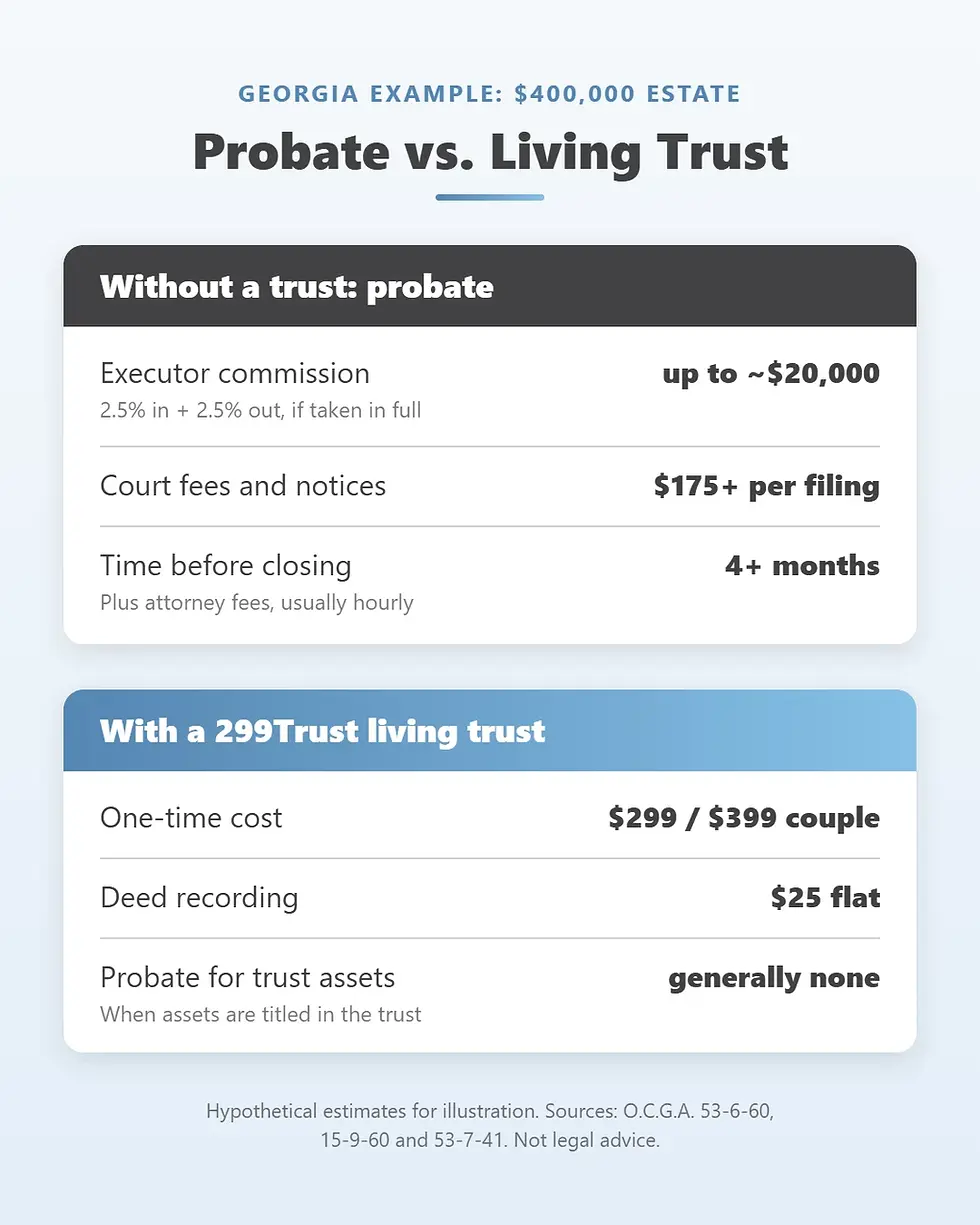
Take a hypothetical $400,000 estate made up of an Atlanta-area home and savings, with no trust. The home is sold and the money is paid out to the heirs. If the personal representative took the full default commission, 2.5% coming in and 2.5% going out could total about $20,000, before attorney fees, court costs, and publication. A living trust in Georgia for the same family costs $299 (or $399 for a couple), paid once. For assets that were titled in the trust, the successor trustee can generally handle the transfer without a probate case. Every estate is different, so these figures are estimates for illustration.
More approaches are covered in our guide on how to avoid probate.
When Can a Georgia Estate Skip Probate?
Some Georgia estates never need a full probate administration. These are the main exceptions under Georgia law.
No administration necessary. When there is no will, the heirs can ask the probate court for an order that no administration is needed. The estate must have no debts, or every creditor must consent, and all heirs must agree in writing on how to divide the property (O.C.G.A. 53-2-40). It is still a court case, and one heir who disagrees can stop it.
Small bank accounts. When there is no will, a Georgia bank may pay up to $15,000 of a deceased person's deposits directly to the surviving spouse, or if none, to the children, parents, or siblings in that order, based on an affidavit (O.C.G.A. 7-1-239). It does not cover a home or anything above that amount.
Joint ownership and beneficiary designations. Accounts with a payable-on-death beneficiary and property owned jointly with survivorship rights generally pass outside probate.
A living trust brings these pieces into one plan. It covers the assets placed in it, names who manages them if the owner can't, and keeps the details out of the public court file.
How Do You Set Up a Living Trust in Georgia?
Setting up a living trust in Georgia generally follows six steps. Some people work with an attorney and others use an online service; our article on whether you can set up a trust without an attorney compares the two.
List the assets. The home, bank and brokerage accounts, vehicles, and any land or rental property.
Choose a successor trustee. This person takes over at death or if the owner can't manage their affairs. Our guide explains what a successor trustee does.
Create the trust document. A Georgia trust must be in writing and signed by the person creating it, and it must name the property, a beneficiary, and a trustee (O.C.G.A. 53-12-20). One Georgia rule matters here: a trust can be changed or revoked only if the document expressly reserves that power (O.C.G.A. 53-12-40). A revocable living trust needs that language. Our guide to revocable vs irrevocable trusts explains the difference.
Sign in front of a notary. Banks and title companies usually expect a notarized signature before they accept a trust.
Fund the trust. Record a new deed moving the Georgia home into the trust, and retitle accounts. Our guides to funding a living trust and putting a house in a trust walk through each step.
Use a certification of trust. Georgia lets a trustee give banks and title companies a short certification instead of the full trust document, which keeps family details private (O.C.G.A. 53-12-280).
Common Mistakes With Georgia Living Trusts
Leaving out the right to revoke. Because Georgia treats a trust as irrevocable unless it says otherwise, a trust meant to be revocable should say so clearly.
Not funding the trust. Signing the trust is only half the job. Assets that are never retitled into it may still go through probate.
Forgetting to record the deed. A Georgia home is not in the trust until a new deed is signed and recorded with the clerk of superior court.
Naming a successor trustee without a backup. If the first choice can't serve, a named backup avoids delays.
Assuming the trust controls every account. Retirement accounts and life insurance pass by their beneficiary designations, so those forms need to match the overall plan.
Expecting tax savings. A revocable living trust does not by itself reduce taxes. Its main purposes are avoiding probate for trust assets, privacy, and planning for incapacity.
Is a Living Trust in Georgia Worth It?
It depends on each person's situation. A Georgia home usually means a probate case unless it is held in a trust or passes by survivorship, which means court filings, published notices, and months of waiting. A living trust tends to be most useful for people who:
Own a home in Georgia.
Own property in another state, which can mean a separate probate case there.
Have minor children and want to nominate a guardian and control when they inherit.
Want privacy, since probate filings are court records.
Want a plan for incapacity, so a successor trustee can step in without a court-appointed conservator.
Estate tax is usually not the reason. Georgia has no estate tax: none is levied on or after July 1, 2014 (Georgia Department of Revenue). The federal estate tax applies only to estates over $15 million per person.
People who rent, have modest savings, and have beneficiaries named on every account may find a will covers their needs. A licensed Georgia attorney can help evaluate a specific situation.
Frequently Asked Questions
Does a living trust in Georgia need to be notarized? Georgia requires a trust to be in writing and signed by the person creating it. Signing in front of a notary is standard practice, and banks and title companies usually expect it before they will move assets into the trust.
Is a will still needed with a living trust? Most trust-based plans include a pour-over will. It moves anything left outside the trust into it, and it is where a guardian for minor children is nominated. A Georgia will must be signed and witnessed by two competent witnesses (O.C.G.A. 53-4-20). Every 299Trust plan includes one. Learn more about the pour-over will.
Does Georgia have an estate tax? No. Georgia has levied no estate tax on or after July 1, 2014.
Can a Georgia living trust be changed later? Yes, if the trust document reserves the power to amend or revoke it. Without that language, Georgia treats a trust as irrevocable.
How long does probate take in Georgia? At least about four months because of the creditor notice period, and many estates take six months to a year or more.
Is 299Trust a law firm? No. 299Trust is do-it-yourself self-help software. It does not give legal advice or represent anyone. Compare 299Trust plans.
Disclaimer: This article is provided for general educational and informational purposes only and does not constitute legal advice. 299Trust is not a law firm and does not provide legal representation. Laws vary by state, and individual circumstances may require consultation with a licensed attorney.


Comments